Regional and District Numbers for Family Dollar Stores in Memphis,tn
| | This article has many bug. Please assistance fix them or discuss these problems on the talk page.
|

The United States dollar (or American dollar) is the official currency (money) of the U.s.a.. It is also used in some other countries exterior the US. Information technology is the standard currency for international markets selling goods such as golden and oil (petrol). When writing, the symbol for the American dollar is the dollar sign ($). Dollars can too be known every bit USD (continuing for 'U.Due south. dollar').
Denominations and value [change | change source]

Front of a U.s. dollar bill
The American ane dollar bill has a picture of George Washington. In that location are currently newspaper bills (currency) of one, 2, 5, 10, 20, 50, and 100 dollars.
All U.S. dollar currency has been the same size, shape and general design since 1928. This is unlike some countries where bank notes with different values have different sizes.
The U.S. also has dollar coins. Some are silver colored and some are aureate colored. Vending machines often give dollar coins as change, since it is easier for the machines to give out coins than paper money. Some of the more than advanced vending machines give out paper money as change. Newspaper dollars are much more than common than dollar coins.
The U.s.a. dollar in subdivided into cents, and 100 cents equals 1 US dollar. 1 cent can exist written equally either $0.01 or 1¢. The cent or "penny" (non to exist dislocated with the English penny sterling) is the least worth coin used in the U.S.. At that place are several different coins with different cent values of unlike materials and sizes. There is the penny (1¢ or $0.01), nickel (v¢ or $0.05), dime (ten¢ or $0.10), quarter (25¢ or $0.25), and the much rarer half-dollar (50¢ or $0.50).[one] All coins and paper bills have the faces of famous Americans on the forepart side.
Federal Reserve [modify | modify source]
The paper "dollar beak" is actually called a "Federal Reserve Note". Federal Reserve notes are legal tender currency notes. The twelve Federal Reserve Banks issue them into apportionment pursuant to the Federal Reserve Human action of 1913. A commercial depository financial institution belonging to the Federal Reserve System can obtain Federal Reserve notes from the Federal Reserve Bank in its district whenever it wishes by paying for them in total, dollar for dollar, from its account with Federal Reserve Bank.
Federal Reserve Banks become the notes from the U.S. Bureau of Engraving and Printing (BEP). It pays the BEP for the cost of producing the notes.
Congress has specified that a Federal Reserve Bank must hold collateral equal in value to the Federal Reserve notes that the Banking company receives. This collateral is chiefly golden certificates and Us securities. This provides backing for the note issue.
Federal Reserve notes are not redeemable in gilded, silverish or any other commodity, and receive no backing by anything. This has been the instance since 1933. The notes take no value for themselves, but for what they volition buy.
The Coinage Act of 1965 titled "Legal tender" states: "United States coins and currency (including Federal reserve notes and circulating notes of Federal reserve banks and national banks) are legal tender for all debts, public charges, taxes, and dues".
This statute means that all United States money as identified above are a valid and legal offer of payment for debts when tendered to a creditor. There is no Federal statute proverb a person or organisation must accept currency or coins as payment for goods and/or services. Private businesses are gratis to develop their ain policies on whether or not to accept greenbacks. But in that location might be a State police which says otherwise. For example, a bus line may prohibit payment of fares in pennies or dollar bills. In addition, motion picture theaters, convenience stores and gas stations may decline to have large denomination currency (usually notes above $xx) as a matter of policy.[2]
Meeting the variable demand for cash [change | change source]
The public typically obtains its cash from banks by withdrawing cash from automatic teller machines (ATMs) or by cashing checks. The corporeality of cash that the public holds varies seasonally, past the mean solar day of the month, and even by the solar day of the calendar week. For example, people demand a large amount of cash for shopping and vacations during the year-terminate holiday flavour. Also, people typically withdraw cash at ATMs over the weekend, so there is more greenbacks in circulation on Monday than on Friday.
To come across the demands of their customers, banks get cash from Federal Reserve Banks. Most medium- and large-sized banks maintain reserve accounts at 1 of the 12 regional Federal Reserve Banks, and they pay for the greenbacks they go from the Fed by having those accounts debited. Some smaller banks maintain their required reserves at larger, "correspondent," banks. The smaller banks go cash through the correspondent banks, which accuse a fee for the service. The larger banks get currency from the Fed and laissez passer it on to the smaller banks.
When the public's demand for cash declines—after the holiday season, for example—banks discover they accept more cash than they need and they deposit the excess at the Fed. Because banks pay the Fed for cash by having their reserve accounts debited, the level of reserves in the nation's banking system drops when the public's need for cash rises; similarly, the level rises over again when the public's demand for cash subsides and banks ship cash back to the Fed. The Fed offsets variations in the public'due south demand for cash that could innovate volatility into credit markets past implementing open market operations.
The popularization of the ATM in contempo years has increased the public's need for currency and, in turn, the amount of currency that banks social club from the Fed. Interestingly, the advent of the ATM has led some banks to request used, fit bills, rather than new bills, because the used bills frequently piece of work better in the ATMs.
Maintaining a cash inventory [change | change source]
Each of the 12 Federal Reserve Banks keeps an inventory of cash on paw to encounter the needs of the depository institutions in its District. Extended custodial inventory sites in several continents promote the utilize of U.S. currency internationally, improve the collection of data on currency flows, and assist local banks run across the public's demand for U.South. currency. Additions to that supply come up direct from the two divisions of the Treasury Department that produce the cash: the Bureau of Engraving and Printing, which prints currency, and the Usa Mint, which makes coins. Nearly of the inventory consists of deposits by banks that had more cash than they needed to serve their customers and deposited the excess at the Fed to help see their reserve requirements.
The U.S. Bureau of Engraving and Printing exchanges more than 40 million dollars' worth of damaged U.S. currency annually.
When a Federal Reserve Bank receives a cash deposit from a bank, it checks the individual notes to determine whether they are fit for future circulation. Well-nigh ane-tertiary of the notes that the Fed receives are not fit, and the Fed destroys them. As shown in the table below, the life of a note varies according to its denomination. For example, a $1 bill, which gets the greatest utilise, remains in circulation an boilerplate of five.9 years; a $100 bill lasts about 15 years. Federal Reserve Banking company of New York on Sun dark Cole
Gallery [alter | alter source]
-
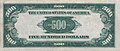
The back only shows the number 500
-
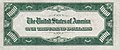
the back of the bill showed just the number 1,000
-
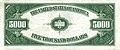
the back only showed the number v,000
-
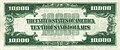
the dorsum of the pecker but showed the number 10,000
-

the dorsum of the pecker showed only the number 100,000
Other websites [modify | change source]
- Heiko Otto (ed.). "Banknotes of the United States" (in English and High german). Retrieved 2017-03-10 .
 Media related to United States dollar at Wikimedia Commons
References [alter | modify source]
- ↑ "Coin Values for The states Coins".
- ↑ "U.Due south. Department of the Treasury".
Source: https://simple.wikipedia.org/wiki/United_States_dollar
0 Response to "Regional and District Numbers for Family Dollar Stores in Memphis,tn"
Postar um comentário